A Triangle with 270 Degrees—and the Assumptions Behind It
Draw a triangle whose angles add up to 270 degrees.
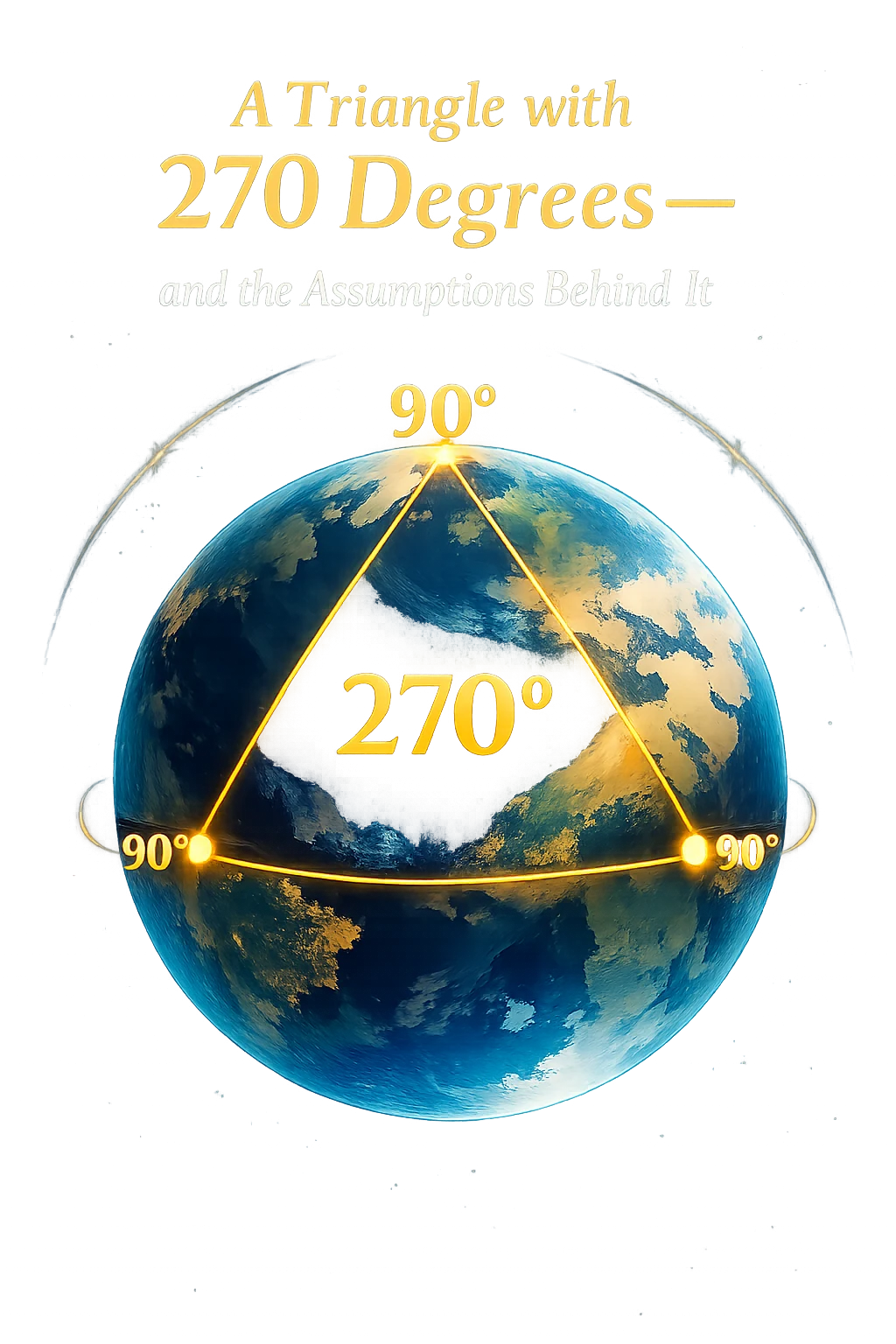
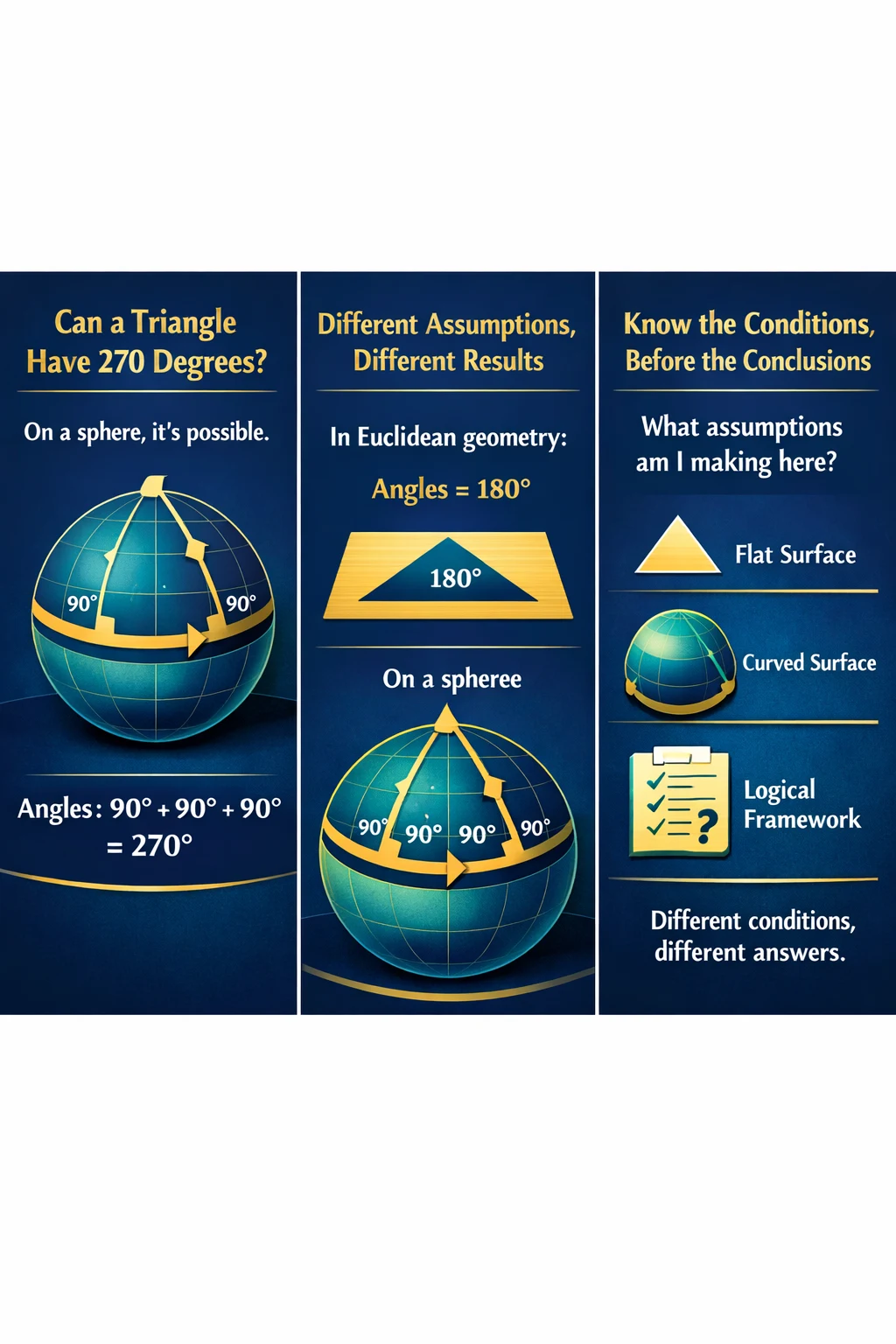
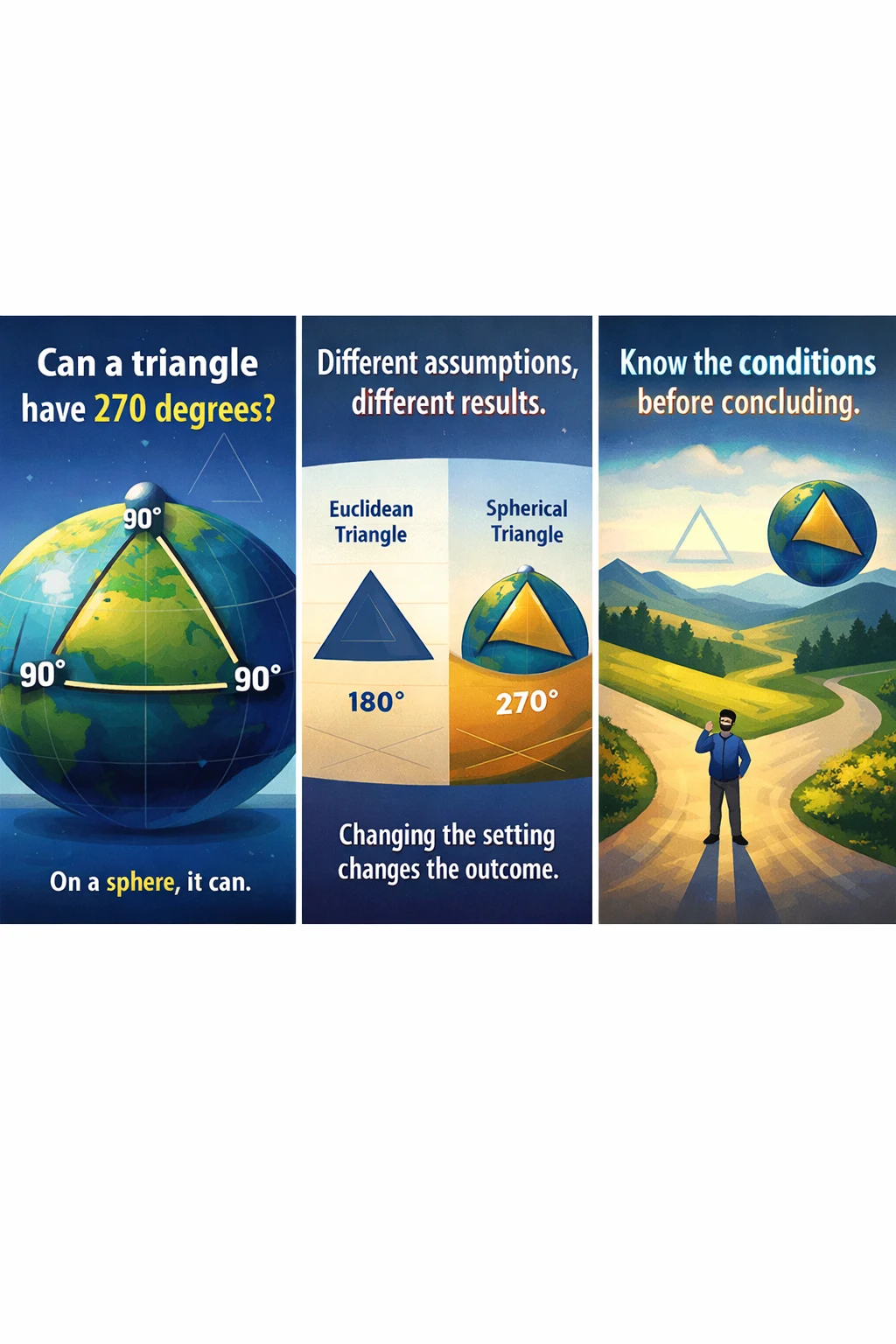
On a sphere, this is possible. Begin at the North Pole and travel south along a meridian to the equator. Follow the equator through 90 degrees of longitude, then return to the North Pole along another meridian. The three sides are arcs of great circles—the sphere’s geodesics. At each vertex, the sides meet at a right angle: the equator crosses each meridian perpendicularly, and the two meridians meet at the pole at 90 degrees. The triangle’s angles total 270 degrees.
This does not refute the Euclidean theorem that a triangle’s angles sum to 180 degrees. It changes the geometric setting. The familiar theorem holds under Euclidean assumptions; on a curved surface, the corresponding result can differ.
We often remember conclusions more readily than the conditions that support them. Repetition can make a conditional truth feel universal—not because the theorem is weak, but because we’ve stopped noticing its scope.
Yet changing the framework is not a license to accept any surprising result. The new assumptions must be stated, the reasoning must be consistent, and the framework must suit the question being asked. A spherical triangle is no counterexample to Euclidean geometry; it answers a different question in a different space.
The challenge is not to distrust familiar results, but to notice when their conditions apply—and when they don’t. What evidence would make you revise the framework you’re using, rather than dismiss an unexpected result as impossible?